Search  
You are here:  Home    

PARTNERS 

3-D Bike Fitting

2-D Video Analysis

TRY FRS For FREE!!!

Offering Altitude Training with Higher Peak

 HOF is the premier sport video analysis company in the South East

hall of productions.JPG


"Your Yoga Connection" as I recommend doing specific yoga poses go to this site.

Your local and regional "Power Cranks Dealer."

Power Cranks

  I Use the Aline System to correct leg alignment for cycling and running!

Aline.jpg

Proud Sponsor of C4
C4New300.jpg

Receive Discounts on Bike Fit if you purchase your bike from:

 hawleys1.gif


VSC's Successful Combination Minimize

"The Bike Fit Expert" 

The VELOSMART.COM mission is simple:

"COMFORT-PERFORMANCE-LONGEVITY"

STUDIO LOCATED AT:  3772 Youngs Rd, Southern Pines, NC 28387

MOBILE RETUL AND VIDEO LAB ANALYSIS AVAILABLE

 NOW OFFERING... YOGA-CYCLING CLINICS FOR 2008! Call to schedule a clinic for yourself, club, or team.

OFFERING VIDEO ANALYSIS for TRIATHLETES (swim stroke, cycling and running gait analysis, and transitions). Click on "Hall of Fame Productions" tab for idea of these services. 

For more detailed information about my bike fitting and range of motion protocol and assessment, refer to the "About" tab and click on "Bike Fit."

  To enable my clients to ride pain free, ride their best, and for a life time:

  • I assess my client's range of motion as well as functional and anatomical abnormalities.
  • Perform a comprehensive rider analysis and positioning on the bike based on their range of motion. by using state of the art Retul 3-D and Dartfish 2-D video analysis technology. 
  • Prescribe specific yoga and conditioning exercises to correct muscle imbalances.
  • Provide follow up sessions for minor adjustments on the bike.
  • Refer clients with major functional problems and repetitive strain injuries to a medical specialist to perform structural integration, muscular manipulation, and/or  "A.R.T." (Active Release Technique).

    VELO SMART COACHING
    OFFERS RETUL 3-D BIKE FITTING TECHNOLOGY TO CYCLISTS AND TRIATHLETES
    I use the Retul 3-D motion capture and analysis technology system for helping my cycling and triathlon clients to provide fast and accurate data collection to aid in bike fitting and avoiding injury. The Retul system uses infra-red LEDs (light emitting diodes) to be placed on the body in specific skeletal locations. Currently the US Triathlon team, Garmin/Slipstream Chipoltle Pro Cycling Team and pro athletes such as Ironman World Champion, Craig Alexander are benefitting from using this technology.
     
    The Retul system collects data and allows me to more effectively analyze the rider to determine accurate saddle and handle bar positions, as well as the position of their feet on the pedals and their wind resistance. These data provides me instant and valuable information to optimize bike fitting, helping to avoid injury during training as well as squeeze out better racing times.
     
    Prior to using the Retul software, all my clients are interviewed and their own “fit” data is stored in client specific files, which can be accessed at any time to compare previous fittings with new data. This “active” system differs from passive systems (similar to those used for motion capture for films and video. Note, I continue to use video analysis for basic bike fits and showing clients how they look on the bike for educational purposes.) in that the tripod mounted LED sensor is tracking the light directly from the source (the LED diodes). This avoids problems of false data encountered by passive systems that use reflective markers which can be confused by additional reflective objects outside the system such as shoes, clothes, or the bike itself.
     
    The system flashes an LED every 2.1 milliseconds (476 times per second) and takes a full set of body measurements every 34 milliseconds, making 29 full sets of body data per second. The sample sizes or duration from the LEDs can be set for 5 seconds to 5 minutes, depending on the requirements of the rider. The Retul software then processes all of that data in seconds, synchronizing the eight data points tracking them across longitudinal, vertical and horizontal planes. After capturing this information, I am able to objectively analyze the data from the sample and evaluate the need for position change. Once the changes are made, the process is repeated to verify effectiveness. This new data then becomes part of the final report, in addition to post-fit bike and equipment measurements.

    Already chosen by the Garmin/Slipstream Chipoltle Pro Cycling Team and pro athletes such as Ironman World Champion, Craig Alexander; the Retul Bike Fitting System is available for you at Velo Smart Coaching. 


    Will Frischkorn settles into Retul data collect mode and David Millar checks his new Felt

    The Retül system is a state-of-the-art motion capture system designed specifically for collecting the most accurate and realistic cycling specific data in three dimensions. By gathering data from eight key anatomical points in your riding position, I am able to profile existing (before) and ideal (after) angles to meet your specific needs.

    The results...more efficiency, power output, performance and comfort.

    Why is a Retul bike fit superior?

    Every rider has unique biomechanics and therefore there are no generalizations that apply when truly fitting a rider to a bike. The Retul system provides sub-millimeter accurate measurements of every moving angle of the body while riding at different workloads – thus providing me with the information needed to fit you to the bike and realistically mimic your ride on the road. 

    Retül optimizes the biomechanics of the rider while taking your goals into consideration:

    • Performance
    • Comfort
    • Injury Prevention

    If you are riding a bike that is not properly fit it can cause frustration, discomfort and pain. Visit Velo Smart Coaching and RETUL (retool) for your positioning and bike fit.
     
    FIT PACKAGES AVAILABLE:
    Velo Smart Pro Fit

    $300
    : Full 3D Cycling Gait Analysis (August 2008 Introductory Offer $150.00)
    Includes evaluation, flexibility and range-of-motion assessment, Retul 3-D motion capture analysis adjustments to bike, cleats, etc 

    • Comprehensive flexibility assessment

    • Complete static assessment of foot, knee, pelvic, and spinal mechanics

    • Full dynamic assessment of these same segments, in the cycling motion, under different power outputs

    • Detailed bicycle positioning to optimize for individual variations in anatomy and movement patterns

    • Measurements of the bicycle position (seat height, set-back, etc.)

    • Suggestions for optimal equipment choices such as crank arm length, stem size, etc.

    • Suggestions for optimal frame geometry

    $125/hour: Additional Bike Fit Analysis
    Use this hourly rate to dial in other bikes, such as time trial, cyclocross, mountain using the Retul 3-D motion capture analysis*

    $100/hour:
    Quick Fit Analysis
    Use this hourly rate (billed quarterly) if you have already had the Velo Smart Coaching Pro Fit and need to adjust new shoes, cleats, saddles, etc.*

    *you must have already had a Velo Smart Coaching Pro Fit in order to use these services.
     

     2-D VIDEO ANALYSIS USING DARTFISH

 THIS CYCLIST HAD THE COMPLETE PACKAGE... GREAT FITNESS AND EQUIPMENT.  HOWEVER, HE WAS IN A LESS EFFECTIVE RIDING POSITION BASED ON HIS MUSCLE STRENGTH AND FLEXIBILITY.  AFTER ANALYSIS AND POSITION MODIFICATION, HE IMPROVED HIS OVERALL PERFORMANCE BY 36 WATTS AND 2.8 MPH AT THE SAME EFFORT AS HIS PRE-TEST.  THE COST BENEFIT ANALYSIS FOR THIS CLIENT WAS 10% OF THE COST FOR A DISC WHEEL.

I PROVIDE DISCOUNT RATES FOR RIDER POSITIONING IF YOU PURCHASE A BICYCLE FROM HAWLEY'S BICYCLE WORLD AND RAINBOW CYCLES.

 Note the side-by-side comparison of the ankle trajectory of the rider.  Can you see the difference?  The athlete's spin is fairly even although he has a pelvic shift.

It is important to note that neglected muscle groups can result in muscle imbalances and greater asymmetry that have an impact on the cyclist’s performance and comfort on the bike.
The detection of muscle imbalances and correcting them before injury occurs is critical to cycling longevity and performance. Most cyclists develop muscle imbalances due to over use of the hip flexors (mobilizers) and under use of weak gluteus muscles (stabilizers). This type of muscle imbalance can cause the pelvis to tilt upward and extend the lumbar spine causing a lordotic tilt (arched lower back) of the pelvis.
Cyclists should conduct periodic screenings for muscle imbalances and correct the abnormalities of muscle strength and length to prevent musculoskeletal pain and irregular function. Evaluating muscle length is not difficult via standardized tests. However, evaluating muscle strength can be more challenging. The primary focus on evaluating muscle strength is to be able to isolate the action of individual muscles. The majority of muscle strength evaluation concentrates on testing the mobilizers (hamstrings, adductors, hip flexors and abdominal recti) because they are easier to isolate than stabilizers (transversus abdominis and posterior glutei mediae). If the cyclist is unfamiliar with muscle imbalance testing they should look for a professional to evaluate them and make sure a protocol is established to assess both the mobilizers and stabilizers.
As discussed earlier, muscle imbalances can cause a lordotic tilt of the pelvis. The tilt of the pelvis can also be more pronounced on one side of the body due to asymmetry where one side of the body is more dominant than the other.
There are many factors to consider when addressing muscle asymmetry. However, there are two primary factors that cause muscle asymmetry while riding the bike. The first is bike fit and proper rider positioning on the bike. Muscle asymmetry will become more pronounced if the rider is on the bike incorrectly. The cyclist is on their bike correctly if he or she is able to engage their core muscles while sitting on the saddle of the bike. If the cyclist cannot engage their core muscles, there is dysfunctional stabilization and no lumbopelvic stability. When the cyclist lacks core stability he or she will be pedaling outside their natural alignment and more muscular effort is required to recover to a stable position. In short, while pedaling long distances the dominant side muscles groups begin to work more than the less dominant side muscle groups, thus causing more muscle asymmetry.
The second factor to consider when addressing muscle asymmetry is the cyclist’s riding habits. For example, reaching down for a water bottle with the same hand reinforces muscle asymmetry. Another example is while stopping at an intersection and extending the same leg to the ground while the other leg remains contracted reinforces muscle asymmetry. A third example is looking back over the same shoulder when checking for traffic reinforces muscle asymmetry. To test your level of asymmetry do what I call “the one-armed interval.”
To do the “one-armed interval” all you do is ride your bike for 10 minutes with only one arm on the handle bars at an easy pace. Then switch arms and ride another 10 minutes with only the other arm on the handle bars. If you are right side dominant, you will notice while riding with your right hand on the handle bars and your left hand off the bars, your left glutes (stabilizers) and left side core muscles will be working harder than when you were riding with the left hand on the handle bars. When your left hand is on the handle bars and you are right side dominant, your glutes and right core muscle groups are not nearly as taxed.

There is no easy answer to eliminating muscle imbalances. The only way to prevent or eliminate injuries is to learn where you have muscle imbalances and adjusting them with the correct strengthening and flexibility exercises. Once you understand more about your muscle imbalances begin a daily stretching and strengthening routine. Doing yoga and/or pilates is a great way to strengthen weak muscles and lengthen tight muscles. To effectively address muscle asymmetry, first ensure you are on the bike correctly. Second, avoid doing everything on the bike only in a one-sided manner… mix it up. Third, do “one-armed intervals” to condition your weaker side.

Note the Right Side (the picture is flipped to show closer comparison).  See the "spike" at the top.  The rider has a weaker hip flexor and is not as efficient... less doriflexion.

$150.00 for Video analysis Bike Fit.  This is a very good bike fit option.  However, it is not as detailed as the Retul 3-D Bike Fit Analysis.

Greg Combs is a cyclist and coach for more than 30 years and is considered an expert in bike fit and rider positioning. For more information email him at gcombs@methodist.edu or call 910.528.4365.


Print  

Tim's Aero Position for Upcoming Season - Monday, October 09, 2006 Minimize
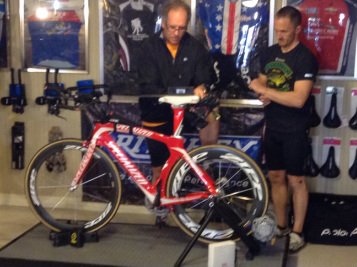
I was able to analyze Tim's position on the bike in many ways.  The photo only shows his angle at leg extension, but using Dartfish, I was able to analyze the angles throughout the pedal stroke.  As well, his knee and ankle trajectory can be compared and analyzed.  Another, aspect I look for is aerodynamics.  By using Dartfish Video Analysis I can analyze aerodynamics from many perspectives.
Print  

Welcome to Velo Smart Coaching


thomas comparison.jpg

Above is a comparison of Thomas' position.  The photo on the left shows Thomas is too stretched out.  His seat was too far back and too low based on his flexibilty and range of motion.  During Thomas's first power test he produced 175 watts.  After making adjustments to Thomas' position, he was more comfortable and more efficient on the bike (However, still needs to order a shorter stem.).  His second power test was 199 watts.  That is a 22 watt improvement.  Twenty two watts is a huge increase of power for a 70 pound athlete.  

Print  


Copyright 2004-2008 Velo Smart Coaching Terms Of Use Privacy Statement